





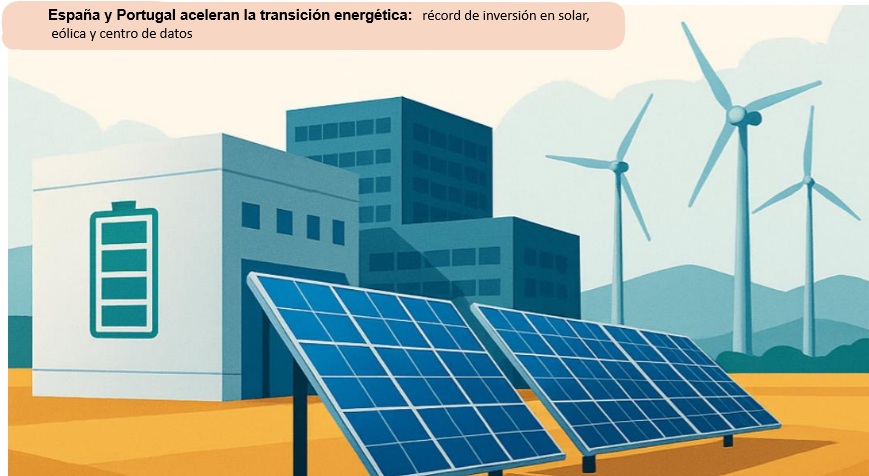
Madrid / Lisbon, July 18, 2025 — Spain and Portugal continue to position themselves as leaders in the European energy transition. During the first half of 2025, both countries have experienced unprecedented growth in the installation of solar plants, wind farms, and energy-efficient data centers, driven by a favorable regulatory environment and a commitment to the 2030 climate targets.
Strong momentum for solar energy
Spain has exceeded 5,000 MW of new photovoltaic power so far this year, consolidating its position as a solar benchmark in Europe. Companies such as Iberdrola, Naturgy, and Quántica are leading projects that combine solar generation with battery storage systems, enabling greater grid stability and efficiency in industrial self-consumption.
Portugal, for its part, has announced new solar plants in strategic regions such as Alentejo and Algarve, with high levels of irradiation and strong institutional support.
Green data centers: a new strategic energy demand
The exponential growth of artificial intelligence, cloud processing, and edge computing has driven the development of sustainable data centers.
- In Spain, the energy demand associated with data centers is expected to triple by 2026, with Madrid, Barcelona, and Malaga as key hubs.
- In Portugal, the market has reached USD 947 million in 2024, with forecasts exceeding USD 3 billion in 2030, highlighting the technology hubs of Lisbon and Sines.
These centers are being designed to operate with 100% renewable energy, strengthening the synergy between digitalization and sustainability.
Wind energy and hybrid projects on the rise
Spain already has more than 30 GW of installed wind power, representing approximately 23% of its electricity mix. In 2025, new wind farms were connected in Castile and León, Aragon, Andalusia, and Galicia. The development of solar-wind hybrid projects is gaining prominence, optimizing existing resources and improving grid integration.
Portugal is making progress in modernizing existing farms and opening auctions for new offshore developments in the Atlantic.
Hybridization and storage: the key to the energy model of the future
The combination of different renewable technologies in the same location, together with energy storage systems, is transforming the generation model. This strategy allows for:
- Reduced connection costs
- Increased supply reliability
- Improve asset profitability
Developers such as Forestalia, Capital Energy, and Endesa are leading projects of this type, which will be key to ensuring a stable and competitive supply.
An attractive environment for investment
The Iberian market has recorded more than €6.2 billion in mergers, acquisitions, and financing of renewable projects in the first half of 2025. Legal certainty, solar and wind potential, and growing demand from the technology sector make the Iberian Peninsula a priority destination for international investors.
2030 targets: clean, digital, and secure energy
- Spain has set itself the target of reaching 81 GW of installed renewable capacity by 2030.
- Portugal plans to cover 85% of its electricity demand with renewable sources by the same year.
Both countries are moving steadily towards a decarbonized, digitized, and resilient energy model, reinforcing their role as European leaders in sustainability and technological efficiency.